FDA approved for patients 2 years and older with obesity due to BBS

Help switch on the POWER of the PATHWAY

Actor portrayals

IMCIVREE is the first and only treatment that targets impairment of the hypothalamic MC4R pathway, a root cause of hyperphagia and obesity due to Bardet-Biedl syndrome (BBS).1-3

Doctor on lift in front of large brain, activating MC4R pathway switch

Actor portrayals

Target a root cause of hyperphagia and obesity in BBS

Impaired MC4R pathway function2,4,5

Unlike general obesity, a root cause of obesity due to BBS is impairment of the MC4R pathway, which can occur due to ciliary dysfunction.

In people with BBS, a variant in one or more BBS genes can disrupt the BBSome.* This causes ciliary dysfunction and disruption of LEPR signaling.

Alpha-melanocyte stimulating hormone (α-MSH) production is impaired or deficient, preventing activation of the MC4 receptor.

Impairment of the MC4R pathway leads to decreased satiety signaling, hyperphagia, and reduced energy expenditure. This often leads to early-onset obesity.
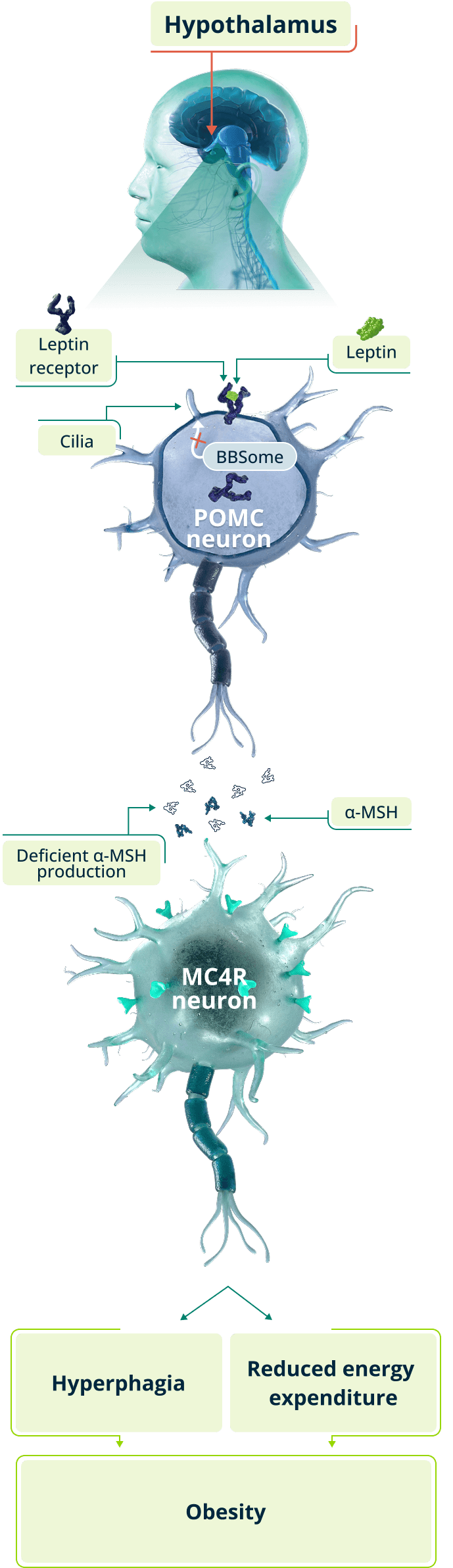
MC4R pathway impairment in BBS showing disrupted signaling leading to reduced satiety and increased hunger
Impaired MC4R pathway function: In people with BBS, a variant in one or more BBS genes can disrupt the BBSome, which causes ciliary dysfunction and disruption of LEPR signaling. α-MSH is impaired or deficient, preventing activation of the MC4 receptor. This leads to impairment of the MC4R pathway, which leads to decreased satiety signaling, hyperphagia, and reduced energy expenditure. This often leads to early-onset obesity.

*BBSome: A complex of proteins formed by a host of BBS genes.

Reestablished MC4R pathway function1,6,7

IMCIVREE, an MC4R agonist, targets a root cause of obesity due to BBS.

IMCIVREE acts in place of α-MSH to activate the MC4 receptor and help restore MC4R pathway function.

Reestablished pathway function helps to bring hunger and satiety signals, and energy expenditure, into balance. This can lead to reduced weight.
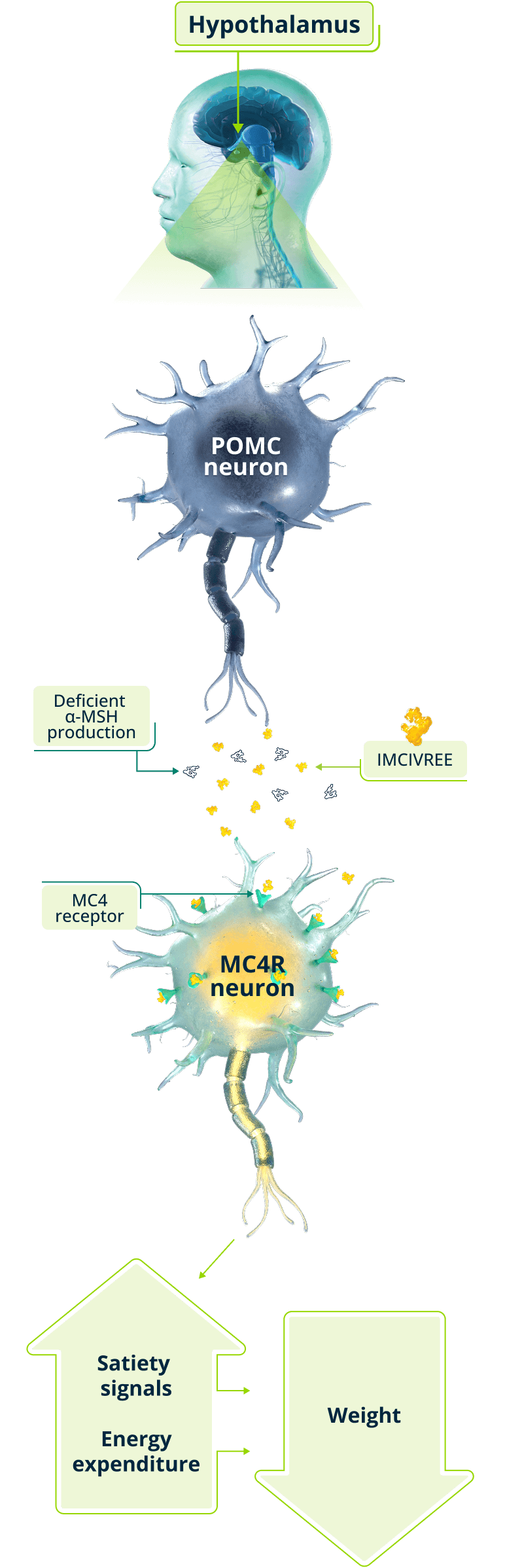
MC4R pathway restoration mechanism showing IMCIVREE activating the receptor to restore hunger and energy balance
Reestablished MC4R pathway function: IMCIVREE, an MC4R agonist, targets a root cause of obesity due to BBS. IMCIVREE acts in place of α-MSH to activate the MC4 receptor and help restore MC4R pathway function, which helps to bring hunger and satiety signals, and energy expenditure, into balance. This can lead to reduced weight.

IMCIVREE helps reestablish and maintain MC4R pathway function, providing the foundation for effective long-term treatment of obesity due to BBS.1,8

About BBS2,9-12

Bardet-Biedl syndrome (BBS) is a rare autosomal recessive ciliopathy that is clinically and genetically diverse.

Along with other signs and symptoms, BBS is associated with impairment of the hypothalamic MC4R pathway. This impairment is present at birth and can lead to:

Infant icon

Early-onset obesity

Hyperphagia icon - Food surrounded by thought bubble

Hyperphagia

Knowing a root cause of your patient’s hyperphagia and early-onset obesity can be an important first step in making an accurate diagnosis, which can lead to optimal management of their disease.

Explore resources for more information on diagnosing BBS in your patients.

Learn more about IMCIVREE for your patients with obesity due to BBS.

α-MSH=alpha-melanocyte-stimulating hormone, LEPR=leptin receptor, MC4R=melanocortin-4 receptor, POMC= proopiomelanocortin

Indication

IMCIVREE is indicated to reduce excess body weight and maintain weight reduction long term in adults and pediatric patients aged 2 years and older with syndromic or monogenic obesity due to Bardet-Biedl syndrome (BBS).

Limitations of Use

IMCIVREE is not indicated for the treatment of patients with the following conditions as IMCIVREE would not be expected to be effective:

  • Other types of obesity not related to BBS or other FDA-approved indications for IMCIVREE, including obesity associated with other genetic syndromes and general (polygenic) obesity

Important Safety Information

Contraindications

Prior serious hypersensitivity to setmelanotide or any of the excipients in IMCIVREE. Serious hypersensitivity reactions (e.g., anaphylaxis) have been reported.

Warnings and Precautions

Disturbance in Sexual Arousal: Spontaneous penile erections and increased frequency of penile erections in males have occurred. Inform patients that these events may occur and instruct patients who have an erection lasting longer than 4 hours to seek emergency medical attention.

Depression and Suicidal Ideation: Depression and suicidal ideation have occurred. Monitor patients for new onset or worsening depression or suicidal thoughts or behaviors. Consider discontinuing IMCIVREE if patients experience suicidal thoughts or behaviors, or clinically significant or persistent depression symptoms occur.

Hypersensitivity Reactions: Serious hypersensitivity reactions (e.g., anaphylaxis) have been reported. If suspected, advise patients to promptly seek medical attention and discontinue IMCIVREE.

Skin Hyperpigmentation, Darkening of Pre-existing Nevi, and Development of New Melanocytic Nevi: Generalized or focal increases in skin pigmentation occurred in the majority of IMCIVREE-treated patients. IMCIVREE may also cause development of new melanocytic nevi or darkening of pre-existing nevi. Perform a full body skin examination prior to initiation and periodically during treatment to monitor pre-existing and new pigmented lesions.

Adverse Reactions

  • Most common adverse reactions (incidence ≥20%) included skin hyperpigmentation, injection site reactions, nausea, and spontaneous penile erection

Use in Specific Populations

Treatment with IMCIVREE is not recommended when breastfeeding. Discontinue IMCIVREE when pregnancy is recognized unless the benefits of therapy outweigh the potential risks to the fetus.

Please see full Prescribing Information for additional Important Safety Information.

References: 1. IMCIVREE [prescribing information]. Boston, MA. Rhythm Pharmaceuticals, Inc., 2026. 2. Beales PL, Cetiner M, Haqq AM, et al. Hyperphagia in Bardet-Biedl syndrome: Pathophysiology, burden, and management. Obes Rev. 2025;26(7):e13915. doi:10.1111/obr.13915 3. Approved Drug Products with Therapeutic Equivalence Evaluations. 45th ed. Food and Drug Administration; 2025:1756. 4. Blaess S, Wachten D. The BBSome: a nexus controlling energy metabolism in the brain. J Clin Invest. 2021;131(8):e148903. doi:10.1172/JCI148903 5. Huvenne H, Dubern B, Clément K, Poitou C. Rare genetic forms of obesity: clinical approach and current treatments in 2016. Obes Facts. 2016;9(3):158-173. doi:10.1159/000445061 6. Haws R, Brady S, Davis E, et al. Effect of setmelanotide, a melanocortin-4 receptor agonist, on obesity in Bardet-Biedl syndrome. Diabetes Obes Metab. 2020;22(11):2133-2140. doi:10.1111/dom.14133 7. Trapp CM, Censani M. Setmelanotide: a promising advancement for pediatric patients with rare forms of genetic obesity. Curr Opin Endocrinol Diabetes Obes. 2023;30(2):136-140. doi:10.1097/MED.0000000000000798 8. Haqq AM, Chung WK, Dollfus H, et al. Efficacy and safety of setmelanotide, a melanocortin-4 receptor agonist, in patients with Bardet-Biedl syndrome and Alström syndrome: a multicentre, randomised, double-blind, placebo-controlled, phase 3 trial with an open-label period. Lancet Diabetes Endocrinol. 2022;10(12):859-868. doi:10.1016/S2213-8587(22)00277-7 9. Forsythe E, Kenny J, Bacchelli C, Beales PL. Managing Bardet-Biedl syndrome–now and in the future. Front Pediatr. 2018;6:23. doi:10.3389/fped.2018.00023 10. Eneli I, Xu J, Webster M, et al. Tracing the effect of the melanocortin-4 receptor pathway in obesity: study design and methodology of the TEMPO registry. Appl Clin Genet. 2019;12:87-93. doi:10.2147/TACG.S199092 11. Hampl SE, Hassink SG, Skinner AC, et al. Clinical practice guideline for the evaluation and treatment of children and adolescents with obesity. Pediatrics. 2023;151(2):e2022060640 12. Manara E, Paolacci S, D'Esposito F, et al. Mutation profile of BBS genes in patients with Bardet-Biedl syndrome: an Italian study. Ital J Pediatr. 2019;45(1):72. doi:10.1186/s13052-019-0659-1

Indication and Important Safety Information

Indication

IMCIVREE is indicated to reduce excess body weight and maintain weight reduction long term in adults and pediatric patients aged 2 years and older with syndromic or monogenic obesity due to Bardet-Biedl syndrome (BBS).

Limitations of Use

IMCIVREE is not indicated for the treatment of patients with the following conditions as IMCIVREE would not be expected to be effective:

  • Other types of obesity not related to BBS or other FDA-approved indications for IMCIVREE, including obesity associated with other genetic syndromes and general (polygenic) obesity

Important Safety Information

Contraindications

Prior serious hypersensitivity to setmelanotide or any of the excipients in IMCIVREE. Serious hypersensitivity reactions (e.g., anaphylaxis) have been reported.

Warnings and Precautions

Disturbance in Sexual Arousal: Spontaneous penile erections and increased frequency of penile erections in males have occurred. Inform patients that these events may occur and instruct patients who have an erection lasting longer than 4 hours to seek emergency medical attention.

Depression and Suicidal Ideation: Depression and suicidal ideation have occurred. Monitor patients for new onset or worsening depression or suicidal thoughts or behaviors. Consider discontinuing IMCIVREE if patients experience suicidal thoughts or behaviors, or clinically significant or persistent depression symptoms occur.

Hypersensitivity Reactions: Serious hypersensitivity reactions (e.g., anaphylaxis) have been reported. If suspected, advise patients to promptly seek medical attention and discontinue IMCIVREE.

Skin Hyperpigmentation, Darkening of Pre-existing Nevi, and Development of New Melanocytic Nevi: Generalized or focal increases in skin pigmentation occurred in the majority of IMCIVREE-treated patients. IMCIVREE may also cause development of new melanocytic nevi or darkening of pre-existing nevi. Perform a full body skin examination prior to initiation and periodically during treatment to monitor pre-existing and new pigmented lesions.

Adverse Reactions

  • Most common adverse reactions (incidence ≥20%) included skin hyperpigmentation, injection site reactions, nausea, and spontaneous penile erection

Use in Specific Populations

Treatment with IMCIVREE is not recommended when breastfeeding. Discontinue IMCIVREE when pregnancy is recognized unless the benefits of therapy outweigh the potential risks to the fetus.

Please see full Prescribing Information for additional Important Safety Information.

References:1. IMCIVREE [prescribing information]. Boston, MA. Rhythm Pharmaceuticals, Inc., 2026.2. Beales PL, Cetiner M, Haqq AM, et al. Hyperphagia in Bardet-Biedl syndrome: Pathophysiology, burden, and management. Obes Rev. 2025;26(7):e13915. doi:10.1111/obr.139153. Approved Drug Products with Therapeutic Equivalence Evaluations. 45th ed. Food and Drug Administration; 2025:1756.4. Blaess S, Wachten D. The BBSome: a nexus controlling energy metabolism in the brain. J Clin Invest. 2021;131(8):e148903. doi:10.1172/JCI1489035. Huvenne H, Dubern B, Clément K, Poitou C. Rare genetic forms of obesity: clinical approach and current treatments in 2016. Obes Facts. 2016;9(3):158-173. doi:10.1159/0004450616. Haws R, Brady S, Davis E, et al. Effect of setmelanotide, a melanocortin-4 receptor agonist, on obesity in Bardet-Biedl syndrome. Diabetes Obes Metab. 2020;22(11):2133-2140. doi:10.1111/dom.141337. Trapp CM, Censani M. Setmelanotide: a promising advancement for pediatric patients with rare forms of genetic obesity. Curr Opin Endocrinol Diabetes Obes. 2023;30(2):136-140. doi:10.1097/MED.00000000000007988. Haqq AM, Chung WK, Dollfus H, et al. Efficacy and safety of setmelanotide, a melanocortin-4 receptor agonist, in patients with Bardet-Biedl syndrome and Alström syndrome: a multicentre, randomised, double-blind, placebo-controlled, phase 3 trial with an open-label period. Lancet Diabetes Endocrinol. 2022;10(12):859-868. doi:10.1016/S2213-8587(22)00277-79. Forsythe E, Kenny J, Bacchelli C, Beales PL. Managing Bardet-Biedl syndrome–now and in the future. Front Pediatr. 2018;6:23. doi:10.3389/fped.2018.0002310. Eneli I, Xu J, Webster M, et al. Tracing the effect of the melanocortin-4 receptor pathway in obesity: study design and methodology of the TEMPO registry. Appl Clin Genet. 2019;12:87-93. doi:10.2147/TACG.S19909211. Hampl SE, Hassink SG, Skinner AC, et al. Clinical practice guideline for the evaluation and treatment of children and adolescents with obesity. Pediatrics. 2023;151(2):e202206064012. Manara E, Paolacci S, D'Esposito F, et al. Mutation profile of BBS genes in patients with Bardet-Biedl syndrome: an Italian study. Ital J Pediatr. 2019;45(1):72. doi:10.1186/s13052-019-0659-1