Meaningful weight reduction in adults

In patients 18 years and older with obesity due to BBS

IMCIVREE delivered early, significant, and sustained weight reduction1,2

~8% mean BMI reduction after 1 year in children and adults 6 years and older3

The efficacy and safety of IMCIVREE for the reduction of weight and hunger in patients 6 years and older with obesity due to BBS were studied in a Phase 3 trial with a randomized, double-blind, placebo-controlled period.

Weight Reduction in Patients 18 Years and Older1,2,4,5
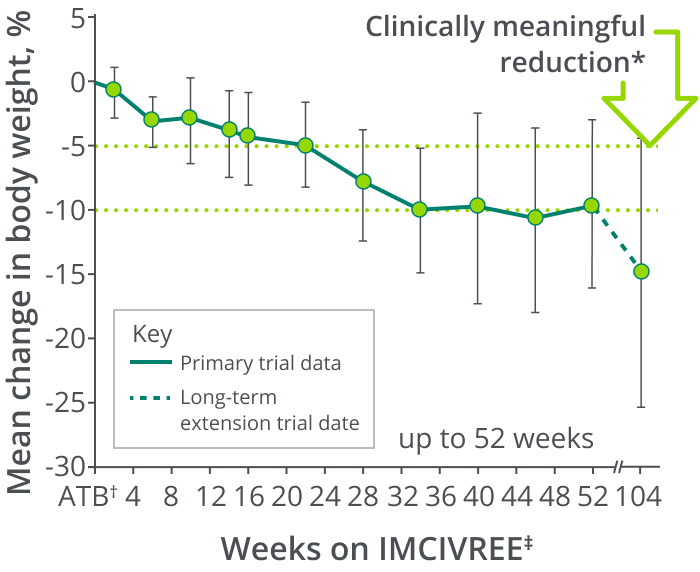
Mean weight reduction at Week 52 in adults with BBS showing clinically meaningful decrease
In patients 18 years and older with obesity due to BBS, there was a clinically meaningful ~10% mean weight reduction at Week 52.

Clinically meaningful

~10% mean weight reduction in

patients ≥18 years of age at Week 521,5

At 24 months, patients in a long-term extension trial experienced a mean ~15% reduction in body weight.4

Mean change in body weight in patients 18 years and older is an exploratory endpoint.

*A clinically meaningful reduction is considered a ≥5% reduction in body weight.1

ATB=active treatment baseline, defined as the last measurement before the first dose of IMCIVREE, ie, week 0 for the IMCIVREE group and week 14 for the placebo group.1

Data shown only include patients who received 52 weeks of IMCIVREE at the time of the analysis.1

§For patients aged 18 years or older, population sizes ranged from 7 to 15, with n=12 at 52 weeks on active treatment. Error bars are the standard deviation.1

Individual Results in Patients 18 Years and Older
Percentage Change in Weight After 52 Weeks (n=12)5

Individual weight reduction outcomes in adults with BBS showing percentage achieving ≥5% weight loss at Week 52
Individual results: 75% of patients 18 years and older with obesity due to BBS achieved a clinically meaningful 5% reduction in weight after 52 weeks.

75% of patients achieved

a clinically meaningful 5% reduction in weight5

Patients were not required to change their diet or exercise routine.1

Patients with data after 52 weeks of treatment.5

Change in BMI in Patients 18 Years and Older1,4,6
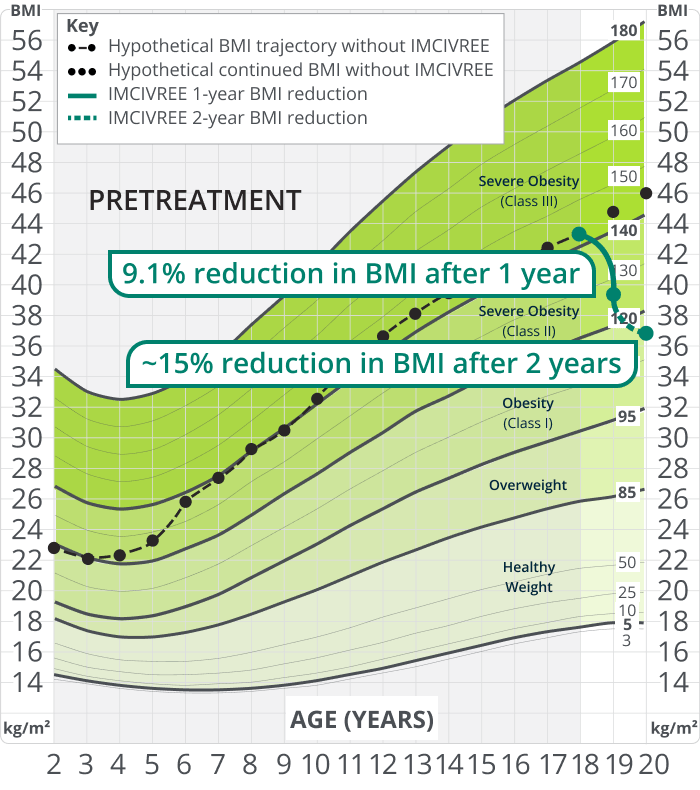
Hypothetical BMI reduction over 1 and 2 years in an adult with BBS treated with IMCIVREE
This chart is a visual representation of what a hypothetical adult with BBS who started IMCIVREE at 18 years of age may experience in BMI reduction after 1 year and 2 years, based on data from the Phase 3 trial and a separate long-term extension trial. IMCIVREE significantly reduced the severity of obesity due to BBS.

IMCIVREE significantly reduced the severity

of obesity due to BBS1,4

This chart is a visual representation of what a hypothetical adult with BBS# who started IMCIVREE at 18 years of age may experience in BMI reduction after 1 year and 2 years, based on data from the Phase 3 trial and a separate long-term extension trial.ab

#Not an actual patient.

aPatients with data after 1 year of treatment.1,4

bGrowth chart is based on females 2 to 20 years of age and is for illustrative purposes only.6

In Patients 18 Years and Older
Weight Changes During the 14-week, Double-blind, Placebo-controlled Period7
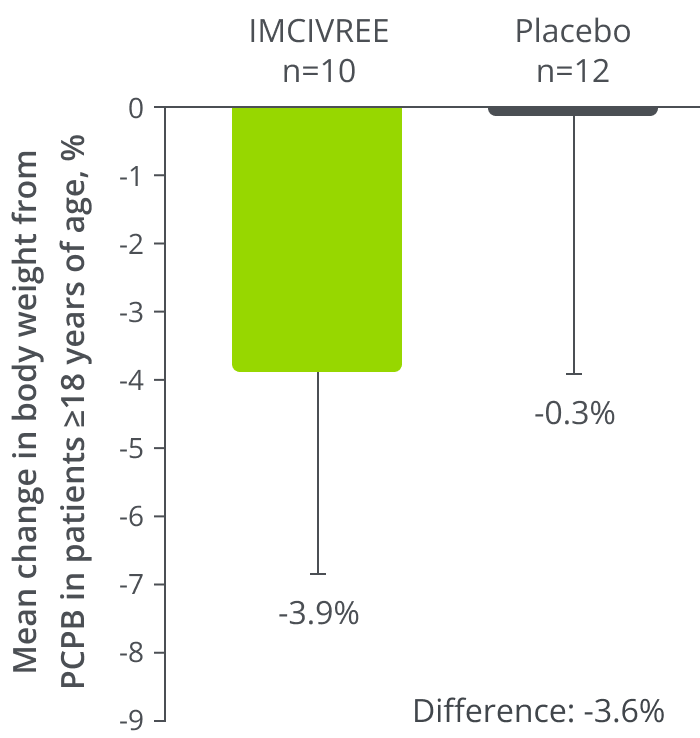
Weight change comparison between IMCIVREE and placebo in adults with BBS showing greater reduction with treatment
In patients 18 years and older with obesity due to BBS, there was a 13x greater weight reduction with IMCIVREE. There was a difference between IMCIVREE and placebo of -3.6%.

13× greater weight reduction

with IMCIVREE7

Results from a combination of pivotal and supplemental patient subpopulations were based on post hoc analysis. Supplemental patients were enrolled after the pivotal cohort had begun treatment. None of the supplemental patients had completed 52 weeks of IMCIVREE treatment at the time of data analysis.1

IMCIVREE delivered sustained and improved weight reduction at 24 months4**

~15% reduction

in body weight

Results from a long-term extension study in patients ≥18 years of age with BBS (n=6):

  • At completion of an index trial, 19 patients who enrolled in a separate open-label, long-term extension study had received at least 24 months of IMCIVREE
  • Patients to be assessed every 3 months until the end of the study (up to 5 years or patient withdrawal)

One patient discontinued due to an AE unrelated to IMCIVREE.

**Compared with measures at index trial baseline.

Hunger reduction in patients 12 years and older with obesity due to BBS1

Hunger Scores in the 14-week, Placebo-controlled, and 52-week Open-label Periods7††

Clinically meaningful
2.1-point reduction

in mean hunger score

at Week 52 in patients 12 and older7‡‡

Patients who switched from placebo to IMCIVREE experienced a rapid reduction in hunger, matching that of patients initially assigned to IMCIVREE.1

Caregiver assessments were also collected for children <12 with obesity due to BBS.§§

††Patients ≥12 years of age who were able to self-report their hunger (n=14) recorded their daily maximal hunger in a diary, which was then assessed by the Daily Hunger Questionnaire Item 2. Hunger was scored on an 11-point scale from 0 (“not hungry at all”) to 10 (“hungriest possible”).3

‡‡During the placebo-controlled period, dose titration to a fixed dose of IMCIVREE 3 mg given subcutaneously once daily was performed during the first 2 weeks of both the placebo-controlled and open-label periods to maintain blinding.3

§§1- to 2-point reduction is considered clinically meaningful.8

¶¶Data not shown.

Before IMCIVREE, I didn’t realize how much time I spent focusing on food, and how much that was affecting my day-to-day and the other things I could be accomplishing.

– Kathryn, who is living with BBS

These are patients that nothing else has ever worked. So to see them so happy about having something that’s finally helping is amazing. Now all they talk about is, “I’m not hungry all the time. I’m not seeking out food all the time. I’m able to do other things.” That shift from the number on the scale to the impact on other parts of life, I really love that.

– Christy Davis, Obesity and Weight Management Specialist

Individual results may vary.

Patient-Reported Health-Related Quality of Life

In the Phase 3 trial in patients 6 years and older with BBS, PedsQL and IWQOL-Lite were assessed as exploratory endpoints and were not powered for formal statistical testing or significance. Change from baseline after approximately 52 weeks of treatment was measured by the age-specific PedsQL or IWQOL-Lite assessments.9

The Impact of Weight on Quality of Life (IWQOL)-Lite is a validated 31-item, self-reported, obesity-specific quality-of-life questionnaire that provides a total score inclusive of 5 domains: physical function, self-esteem, sexual life, public distress, and work. The IWQOL-Lite was administered to patients ≥18 years of age.9

IWQOL-Lite Total Scores in Patients
With BBS ≥18 Years Old
With Baseline and Week 52 Data9##
BaselineEndpoint: Change From Baseline at Week 52
All patients
(n=11)
All patients
(n=11)
IWQOL-Lite total score, mean (SD)74.9 (12.0)+12 (10.3)
  • Raw scores for IWQOL-Lite were transformed on a scale of 0–100, with 0 representing the worst possible HRQOL and 100 the best possible HRQOL9
  • Limitations of these results include small sample sizes across assessments, which may be in part due to the rarity of the disease9

These insights highlight the need to address hyperphagia and subsequent impaired quality of life for people with BBS and their caregivers.9

##Using age-specific PedsQL assessments.9

The Impact of IMCIVREE

Connection icon

Hear from families and clinicians

about how IMCIVREE is bringing hope to people living with obesity due to BBS.

Get your patient started with IMCIVREE.

See efficacy data for IMCIVREE in young children.

AE=adverse event, CI=confidence interval, IWQOL=Impact of Weight on Quality of Life-Lite, PCPB=placebo-controlled period baseline, PedsQL=Pediatric Quality of Life

Indication

IMCIVREE is indicated to reduce excess body weight and maintain weight reduction long term in adults and pediatric patients aged 2 years and older with syndromic or monogenic obesity due to Bardet-Biedl syndrome (BBS).

Limitations of Use

IMCIVREE is not indicated for the treatment of patients with the following conditions as IMCIVREE would not be expected to be effective:

  • Other types of obesity not related to BBS or other FDA-approved indications for IMCIVREE, including obesity associated with other genetic syndromes and general (polygenic) obesity

Important Safety Information

Contraindications

Prior serious hypersensitivity to setmelanotide or any of the excipients in IMCIVREE. Serious hypersensitivity reactions (e.g., anaphylaxis) have been reported.

Warnings and Precautions

Disturbance in Sexual Arousal: Spontaneous penile erections and increased frequency of penile erections in males have occurred. Inform patients that these events may occur and instruct patients who have an erection lasting longer than 4 hours to seek emergency medical attention.

Depression and Suicidal Ideation: Depression and suicidal ideation have occurred. Monitor patients for new onset or worsening depression or suicidal thoughts or behaviors. Consider discontinuing IMCIVREE if patients experience suicidal thoughts or behaviors, or clinically significant or persistent depression symptoms occur.

Hypersensitivity Reactions: Serious hypersensitivity reactions (e.g., anaphylaxis) have been reported. If suspected, advise patients to promptly seek medical attention and discontinue IMCIVREE.

Skin Hyperpigmentation, Darkening of Pre-existing Nevi, and Development of New Melanocytic Nevi: Generalized or focal increases in skin pigmentation occurred in the majority of IMCIVREE-treated patients. IMCIVREE may also cause development of new melanocytic nevi or darkening of pre-existing nevi. Perform a full body skin examination prior to initiation and periodically during treatment to monitor pre-existing and new pigmented lesions.

Adverse Reactions

  • Most common adverse reactions (incidence ≥20%) included skin hyperpigmentation, injection site reactions, nausea, and spontaneous penile erection

Use in Specific Populations

Treatment with IMCIVREE is not recommended when breastfeeding. Discontinue IMCIVREE when pregnancy is recognized unless the benefits of therapy outweigh the potential risks to the fetus.

Please see full Prescribing Information for additional Important Safety Information.

References: 1. Haqq AM, Chung WK, Dollfus H, et al. Efficacy and safety of setmelanotide, a melanocortin-4 receptor agonist, in patients with Bardet-Biedl syndrome and Alström syndrome: a multicentre, randomised, double-blind, placebo-controlled, phase 3 trial with an open-label period. Lancet Diabetes Endocrinol. 2022;10(12):859-868. doi:10.1016/S2213-8587(22)00277-7 2. Grossman DC, Bibbins-Domingo K, et al; US Preventive Services Task Force. Screening for obesity in children and adolescents: US Preventive Services Task Force recommendation statement. JAMA. 2017;317(23):2417-2426. doi:10.1001/jama.2017.6803 3. IMCIVREE [prescribing information]. Boston, MA. Rhythm Pharmaceuticals, Inc., 2026. 4. Argente J, et al. Endocrine Society Annual Meeting. Poster ODP606. June 11-14, 2022. 5. Data on file. Rhythm Pharmaceuticals, Inc. Boston, MA. 6. Gulati AK, Kaplan DW, Daniels SR. Clinical tracking of severely obese children: a new growth chart. Pediatrics. 2012;130(6):1136-1140. doi:10.1542/peds.2012-0596 7. Haqq AM, Chung WK, Dollfus H, et al. Efficacy and safety of setmelanotide, a melanocortin-4 receptor agonist, in patients with Bardet-Biedl syndrome and Alström syndrome: a multicentre, randomised, double-blind, placebo-controlled, phase 3 trial with an open-label period. Lancet Diabetes Endocrinol. 2022;10(12):859-868. doi:10.1016/S2213-8587(22)00277-7. Supplemental appendix available at: https://www.thelancet.com/journals/landia/article/PIIS2213-8587(22)00277-7/fulltext 8. Roth CL, Scimia C, Shoemaker AH, et al. Setmelanotide for the treatment of acquired hypothalamic obesity: a phase 2, open-label, multicentre trial. Lancet Diabetes Endocrinol. 2024;12(6):380-389. doi:10.1016/S2213-8587(24)00087-1 9. Forsythe E, Haws RM, Argente J, et al. Quality of life improvements following one year of setmelanotide in children and adult patients with Bardet-Biedl syndrome: phase 3 trial results. Orphanet J Rare Dis. 2023;18(1):12. doi:10.1186/s13023-022-02602-4

Indication and Important Safety Information

Indication

IMCIVREE is indicated to reduce excess body weight and maintain weight reduction long term in adults and pediatric patients aged 2 years and older with syndromic or monogenic obesity due to Bardet-Biedl syndrome (BBS).

Limitations of Use

IMCIVREE is not indicated for the treatment of patients with the following conditions as IMCIVREE would not be expected to be effective:

  • Other types of obesity not related to BBS or other FDA-approved indications for IMCIVREE, including obesity associated with other genetic syndromes and general (polygenic) obesity

Important Safety Information

Contraindications

Prior serious hypersensitivity to setmelanotide or any of the excipients in IMCIVREE. Serious hypersensitivity reactions (e.g., anaphylaxis) have been reported.

Warnings and Precautions

Disturbance in Sexual Arousal: Spontaneous penile erections and increased frequency of penile erections in males have occurred. Inform patients that these events may occur and instruct patients who have an erection lasting longer than 4 hours to seek emergency medical attention.

Depression and Suicidal Ideation: Depression and suicidal ideation have occurred. Monitor patients for new onset or worsening depression or suicidal thoughts or behaviors. Consider discontinuing IMCIVREE if patients experience suicidal thoughts or behaviors, or clinically significant or persistent depression symptoms occur.

Hypersensitivity Reactions: Serious hypersensitivity reactions (e.g., anaphylaxis) have been reported. If suspected, advise patients to promptly seek medical attention and discontinue IMCIVREE.

Skin Hyperpigmentation, Darkening of Pre-existing Nevi, and Development of New Melanocytic Nevi: Generalized or focal increases in skin pigmentation occurred in the majority of IMCIVREE-treated patients. IMCIVREE may also cause development of new melanocytic nevi or darkening of pre-existing nevi. Perform a full body skin examination prior to initiation and periodically during treatment to monitor pre-existing and new pigmented lesions.

Adverse Reactions

  • Most common adverse reactions (incidence ≥20%) included skin hyperpigmentation, injection site reactions, nausea, and spontaneous penile erection

Use in Specific Populations

Treatment with IMCIVREE is not recommended when breastfeeding. Discontinue IMCIVREE when pregnancy is recognized unless the benefits of therapy outweigh the potential risks to the fetus.

Please see full Prescribing Information for additional Important Safety Information.

References:1. Haqq AM, Chung WK, Dollfus H, et al. Efficacy and safety of setmelanotide, a melanocortin-4 receptor agonist, in patients with Bardet-Biedl syndrome and Alström syndrome: a multicentre, randomised, double-blind, placebo-controlled, phase 3 trial with an open-label period. Lancet Diabetes Endocrinol. 2022;10(12):859-868. doi:10.1016/S2213-8587(22)00277-72. Grossman DC, Bibbins-Domingo K, et al; US Preventive Services Task Force. Screening for obesity in children and adolescents: US Preventive Services Task Force recommendation statement. JAMA. 2017;317(23):2417-2426. doi:10.1001/jama.2017.68033. IMCIVREE [prescribing information]. Boston, MA. Rhythm Pharmaceuticals, Inc., 2026.4. Argente J, et al. Endocrine Society Annual Meeting. Poster ODP606. June 11-14, 2022.5. Data on file. Rhythm Pharmaceuticals, Inc. Boston, MA.6. Gulati AK, Kaplan DW, Daniels SR. Clinical tracking of severely obese children: a new growth chart. Pediatrics. 2012;130(6):1136-1140. doi:10.1542/peds.2012-05967. Haqq AM, Chung WK, Dollfus H, et al. Efficacy and safety of setmelanotide, a melanocortin-4 receptor agonist, in patients with Bardet-Biedl syndrome and Alström syndrome: a multicentre, randomised, double-blind, placebo-controlled, phase 3 trial with an open-label period. Lancet Diabetes Endocrinol. 2022;10(12):859-868. doi:10.1016/S2213-8587(22)00277-7. Supplemental appendix available at: https://www.thelancet.com/journals/landia/article/PIIS2213-8587(22)00277-7/fulltext8. Roth CL, Scimia C, Shoemaker AH, et al. Setmelanotide for the treatment of acquired hypothalamic obesity: a phase 2, open-label, multicentre trial. Lancet Diabetes Endocrinol. 2024;12(6):380-389. doi:10.1016/S2213-8587(24)00087-19. Forsythe E, Haws RM, Argente J, et al. Quality of life improvements following one year of setmelanotide in children and adult patients with Bardet-Biedl syndrome: phase 3 trial results. Orphanet J Rare Dis. 2023;18(1):12. doi:10.1186/s13023-022-02602-4