Meaningful weight reduction in young children

In patients 2 to <6 years old with obesity due to BBS

IMCIVREE delivered early and clinically meaningful weight reduction1,2

~10% mean BMI reduction after 1 year in young children 2 to <6 years old2

The efficacy and safety of IMCIVREE for the reduction of weight were studied in the first-ever Phase 3, open-label clinical trial for children 2 to <6 years old with obesity due to BBS.

BMI Z-score Reduction in Patients 2 to <6 Years Old3*
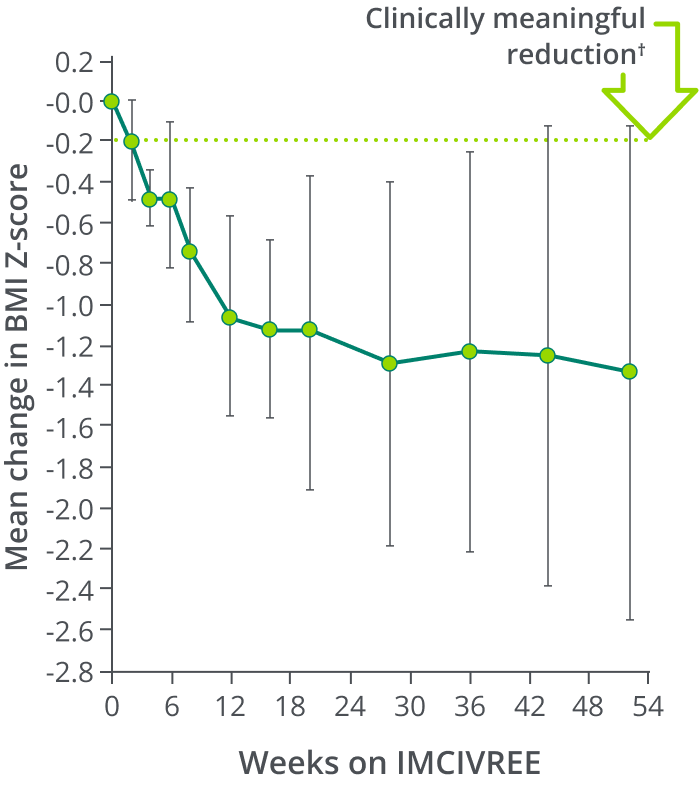
BMI Z-score change at Week 52 in children with BBS showing clinically meaningful reduction
In patients 2 to <6 years old with obesity due to BBS, there was a clinically meaningful -1.3 mean change in BMI Z-score at Week 52.

Clinically meaningful
-1.3 mean change

in BMI Z-score at week 522

A BMI Z-score is a reliable measure of weight in children who are still growing because it accounts for height, age, and gender.4

*Data shown include only patients who received 52 weeks of IMCIVREE at the time of the analysis (n=5).2

A clinically meaningful reduction is generally considered a ≥0.2 reduction in BMI Z-score. A 0.2 reduction is comparable to weight loss of approximately 5%.2,5

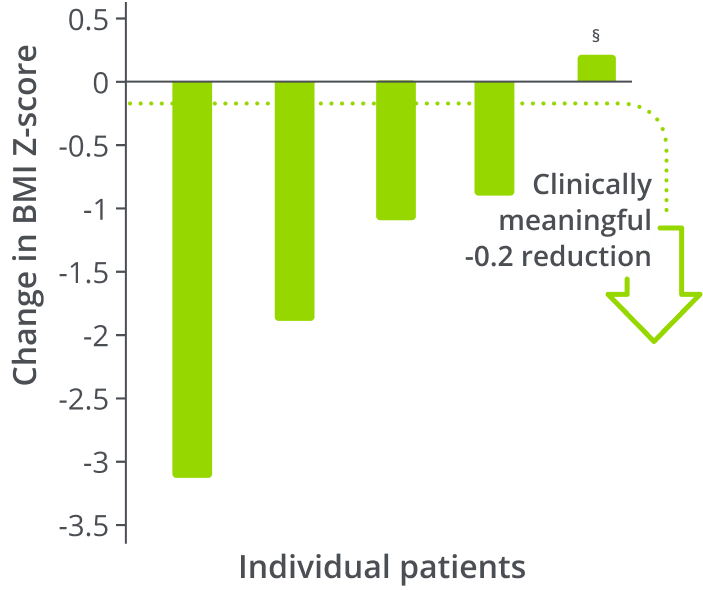
Individual Results in Patients 2 to <6 Years Old
Change in BMI Z-score From Baseline After 52 Weeks (n=5)2

Individual patient outcomes showing BMI Z-score response rates in children aged 2 to <6
Individual results: 80% of patients ages 2 to <6 achieved a clinically meaningful reduction of ≥0.2 in BMI Z-score.

80% of patients

achieved a clinically meaningful reduction of ≥0.2 in BMI Z-score2

Patients were not required to change their diet or exercise routine.6

BMI Z-score was used to measure the reduction in BMI in children. A clinically meaningful reduction is generally considered a ≥0.2 reduction in BMI Z-score. A 0.2 reduction is comparable to weight loss of approximately 5%.2,5

§Patient was not compliant with dosing.2

Change in BMI Percentile in Patients 2 to <6 Years Old2,7
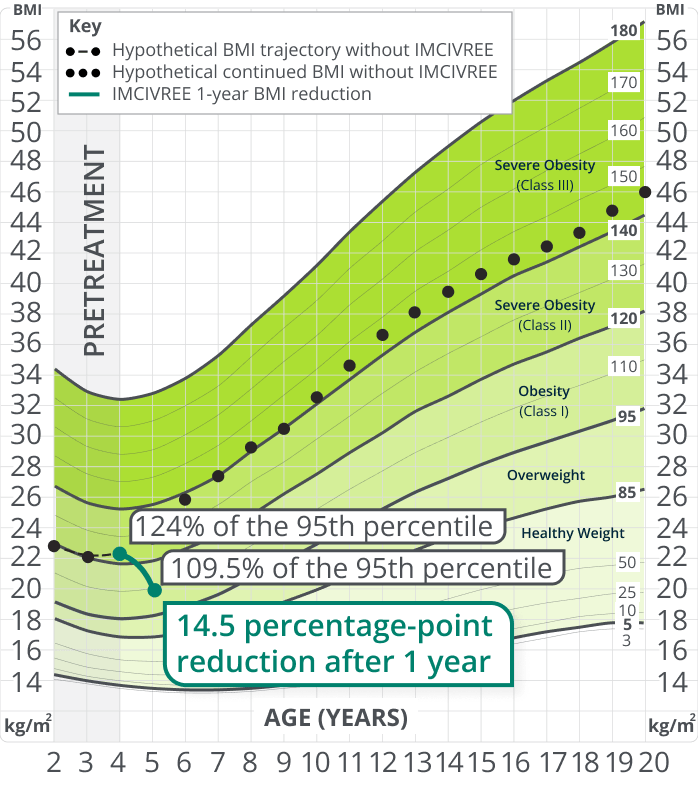
Hypothetical BMI reduction over one year in a child with BBS treated with IMCIVREE
This chart is a visual representation of what a hypothetical child with BBS who started IMCIVREE at age 4 may experience in BMI reduction after 1 year, based on data from the Phase 3 trial. IMCIVREE reduced the severity of obesity due to BBS.

IMCIVREE reduced the severity of obesity due to BBS

This chart is a visual representation of what a hypothetical child with BBS who started IMCIVREE at age 4 may experience in BMI reduction after 1 year, based on data from the Phase 3 trial.

Treating early with IMCIVREE can help lead to a healthier weight-gain trajectory1,2

Growth chart is based on females 2 to 20 years of age and is for illustrative purposes only.7

Get your patient started with IMCIVREE.

See efficacy data for IMCIVREE in children 6 to <18.

BBS=Bardet-Biedl syndrome, BMI=body mass index

Indication

IMCIVREE is indicated to reduce excess body weight and maintain weight reduction long term in adults and pediatric patients aged 2 years and older with syndromic or monogenic obesity due to Bardet-Biedl syndrome (BBS).

Limitations of Use

IMCIVREE is not indicated for the treatment of patients with the following conditions as IMCIVREE would not be expected to be effective:

  • Other types of obesity not related to BBS or other FDA-approved indications for IMCIVREE, including obesity associated with other genetic syndromes and general (polygenic) obesity

Important Safety Information

Contraindications

Prior serious hypersensitivity to setmelanotide or any of the excipients in IMCIVREE. Serious hypersensitivity reactions (e.g., anaphylaxis) have been reported.

Warnings and Precautions

Disturbance in Sexual Arousal: Spontaneous penile erections and increased frequency of penile erections in males have occurred. Inform patients that these events may occur and instruct patients who have an erection lasting longer than 4 hours to seek emergency medical attention.

Depression and Suicidal Ideation: Depression and suicidal ideation have occurred. Monitor patients for new onset or worsening depression or suicidal thoughts or behaviors. Consider discontinuing IMCIVREE if patients experience suicidal thoughts or behaviors, or clinically significant or persistent depression symptoms occur.

Hypersensitivity Reactions: Serious hypersensitivity reactions (e.g., anaphylaxis) have been reported. If suspected, advise patients to promptly seek medical attention and discontinue IMCIVREE.

Skin Hyperpigmentation, Darkening of Pre-existing Nevi, and Development of New Melanocytic Nevi: Generalized or focal increases in skin pigmentation occurred in the majority of IMCIVREE-treated patients. IMCIVREE may also cause development of new melanocytic nevi or darkening of pre-existing nevi. Perform a full body skin examination prior to initiation and periodically during treatment to monitor pre-existing and new pigmented lesions.

Adverse Reactions

  • Most common adverse reactions (incidence ≥20%) included skin hyperpigmentation, injection site reactions, nausea, and spontaneous penile erection

Use in Specific Populations

Treatment with IMCIVREE is not recommended when breastfeeding. Discontinue IMCIVREE when pregnancy is recognized unless the benefits of therapy outweigh the potential risks to the fetus.

Please see full Prescribing Information for additional Important Safety Information.

References: 1. IMCIVREE [prescribing information]. Boston, MA. Rhythm Pharmaceuticals, Inc., 2026. 2. Argente J, Verge CF, Okorie U, et al. Setmelanotide in patients aged 2-5 years with rare MC4R pathway-associated obesity (VENTURE): a 1 year, open-label, multicenter, phase 3 trial. Lancet Diabetes Endocrinol. 2025;13(1):29-37. doi:10.1016/S2213-8587(24)00273-0 3. Data on file. Rhythm Pharmaceuticals, Inc. Boston, MA. 4. Growth Charts: Data file for the CDC Extended BMI-for-Age Growth Charts. Published December 14, 2022. Accessed January 9, 2026. https://www.cdc.gov/growthcharts/extended-bmi-data-files.htm 5. Grossman DC, Bibbins-Domingo K, et al; US Preventive Services Task Force. Screening for obesity in children and adolescents: US Preventive Services Task Force recommendation statement. JAMA. 2017;317(23):2417-2426. doi:10.1001/jama.2017.6803 6. Haqq AM, Chung WK, Dollfus H, et al. Efficacy and safety of setmelanotide, a melanocortin-4 receptor agonist, in patients with Bardet-Biedl syndrome and Alström syndrome: a multicentre, randomised, double-blind, placebo-controlled, phase 3 trial with an open-label period. Lancet Diabetes Endocrinol. 2022;10(12):859-868. doi:10.1016/S2213-8587(22)00277-7 7. Gulati AK, Kaplan DW, Daniels SR. Clinical tracking of severely obese children: a new growth chart. Pediatrics. 2012;130(6):1136-1140. doi:10.1542/peds.2012-0596

Indication and Important Safety Information

Indication

IMCIVREE is indicated to reduce excess body weight and maintain weight reduction long term in adults and pediatric patients aged 2 years and older with syndromic or monogenic obesity due to Bardet-Biedl syndrome (BBS).

Limitations of Use

IMCIVREE is not indicated for the treatment of patients with the following conditions as IMCIVREE would not be expected to be effective:

  • Other types of obesity not related to BBS or other FDA-approved indications for IMCIVREE, including obesity associated with other genetic syndromes and general (polygenic) obesity

Important Safety Information

Contraindications

Prior serious hypersensitivity to setmelanotide or any of the excipients in IMCIVREE. Serious hypersensitivity reactions (e.g., anaphylaxis) have been reported.

Warnings and Precautions

Disturbance in Sexual Arousal: Spontaneous penile erections and increased frequency of penile erections in males have occurred. Inform patients that these events may occur and instruct patients who have an erection lasting longer than 4 hours to seek emergency medical attention.

Depression and Suicidal Ideation: Depression and suicidal ideation have occurred. Monitor patients for new onset or worsening depression or suicidal thoughts or behaviors. Consider discontinuing IMCIVREE if patients experience suicidal thoughts or behaviors, or clinically significant or persistent depression symptoms occur.

Hypersensitivity Reactions: Serious hypersensitivity reactions (e.g., anaphylaxis) have been reported. If suspected, advise patients to promptly seek medical attention and discontinue IMCIVREE.

Skin Hyperpigmentation, Darkening of Pre-existing Nevi, and Development of New Melanocytic Nevi: Generalized or focal increases in skin pigmentation occurred in the majority of IMCIVREE-treated patients. IMCIVREE may also cause development of new melanocytic nevi or darkening of pre-existing nevi. Perform a full body skin examination prior to initiation and periodically during treatment to monitor pre-existing and new pigmented lesions.

Adverse Reactions

  • Most common adverse reactions (incidence ≥20%) included skin hyperpigmentation, injection site reactions, nausea, and spontaneous penile erection

Use in Specific Populations

Treatment with IMCIVREE is not recommended when breastfeeding. Discontinue IMCIVREE when pregnancy is recognized unless the benefits of therapy outweigh the potential risks to the fetus.

Please see full Prescribing Information for additional Important Safety Information.

References:1. IMCIVREE [prescribing information]. Boston, MA. Rhythm Pharmaceuticals, Inc., 2026.2. Argente J, Verge CF, Okorie U, et al. Setmelanotide in patients aged 2-5 years with rare MC4R pathway-associated obesity (VENTURE): a 1 year, open-label, multicenter, phase 3 trial. Lancet Diabetes Endocrinol. 2025;13(1):29-37. doi:10.1016/S2213-8587(24)00273-03. Data on file. Rhythm Pharmaceuticals, Inc. Boston, MA.4. Growth Charts: Data file for the CDC Extended BMI-for-Age Growth Charts. Published December 14, 2022. Accessed January 9, 2026. https://www.cdc.gov/growthcharts/extended-bmi-data-files.htm5. Grossman DC, Bibbins-Domingo K, et al; US Preventive Services Task Force. Screening for obesity in children and adolescents: US Preventive Services Task Force recommendation statement. JAMA. 2017;317(23):2417-2426. doi:10.1001/jama.2017.68036. Haqq AM, Chung WK, Dollfus H, et al. Efficacy and safety of setmelanotide, a melanocortin-4 receptor agonist, in patients with Bardet-Biedl syndrome and Alström syndrome: a multicentre, randomised, double-blind, placebo-controlled, phase 3 trial with an open-label period. Lancet Diabetes Endocrinol. 2022;10(12):859-868. doi:10.1016/S2213-8587(22)00277-77. Gulati AK, Kaplan DW, Daniels SR. Clinical tracking of severely obese children: a new growth chart. Pediatrics. 2012;130(6):1136-1140. doi:10.1542/peds.2012-0596